
From Idea To Launch-Ready Venture
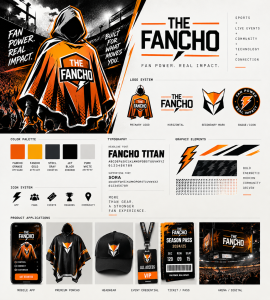
The Fancho started as an entrepreneur with an idea, an early logo, and a product concept that was much bigger than either of them.
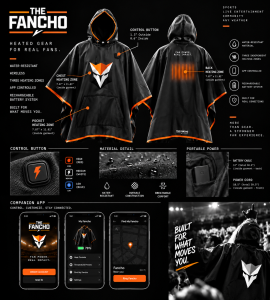
The product was a smart wearable poncho designed for sports and live entertainment: water-resistant, built with three independently controlled heating zones, and supported by a companion app. What began as a branding project quickly expanded into helping figure out what the entire venture needed to become.
I worked alongside my longtime creative partner across the brand, product, digital experience, business model, investor story, sports outreach, and launch preparation.
One Product. Two Very Different Markets.
I started by researching sports and entertainment, live-event culture, fan behavior, wearable technology, competing products, merchandising, and where there was actually room in the market for something new.
The business had two distinct paths.
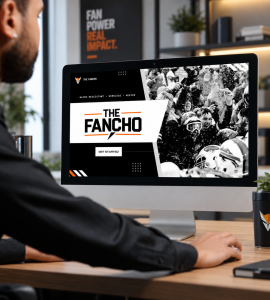
On the D2C side, The Fancho needed to work as its own consumer brand — something a fan could discover, understand, purchase, and use.
On the B2B side, the same underlying product could be white-labeled for collegiate and professional sports organizations, customized in team colors and branding, and sold as official merchandise.
That meant I wasn’t designing for one customer journey. I was communicating with fans, sports organizations, investors, stakeholders, and technical partners — each of whom needed to understand the same idea from a completely different entry point.
Building The Thing, Not Just Dressing It.
My role reached far beyond visual identity.
I worked across brand strategy, creative direction, product design and development, UX, app thinking, landing-page design, investor presentations, stakeholder communication, B2B outreach, marketing, technical documentation, partnership development, and launch strategy.
On the product side, I was thinking about how someone would actually wear it: where the heating zones belonged, how the controls needed to function, how the materials behaved, how someone moved in it, and how the physical product connected back to the app and overall customer experience.
That work also meant understanding the less glamorous details behind what we could responsibly communicate.
One memorable lesson: you cannot casually call something waterproof because it sounds better. The product was water-resistant, so that is what we said.
Small detail, bigger principle: marketing still has to survive contact with reality.
Built For Launch. Limited By Capital.
By the end, The Fancho had evolved from an early idea into a launch-ready sports-tech product and brand with a defined physical experience, consumer identity, companion-app thinking, D2C strategy, B2B white-label model, investor materials, sports outreach, and launch preparation.
We were preparing for a February launch when the founder was ultimately unable to secure the remaining capital needed to launch and sustainably operate the company.
The venture did not make it to market, but the work reached the point it was supposed to reach.
We took an idea, figured out what it needed to become, built the product and brand around it, developed two distinct go-to-market stories, and brought the entire ecosystem to a launch-ready state.
Built To Become Something Real.
The Fancho is one of my clearest examples of working comfortably inside ambiguity — moving between product, technology, brand, business, and audience without treating any of them like separate problems.
The final system was designed to work for the fan wearing it, the organization considering it as merchandise, the investor evaluating the opportunity, and the technical partners responsible for helping make it real.
Explore The Finished Work: